The Cost of Motherhood
There is no universal price tag on motherhood in America—only a staggering range of costs so extreme, they've become a punchline. The Cost of Motherhood is a Spread the Jelly series that looks at the dollar signs attached to pregnancy, postpartum, and beyond. We’re here to explore that range, and what it reveals about the systems women are expected to navigate.
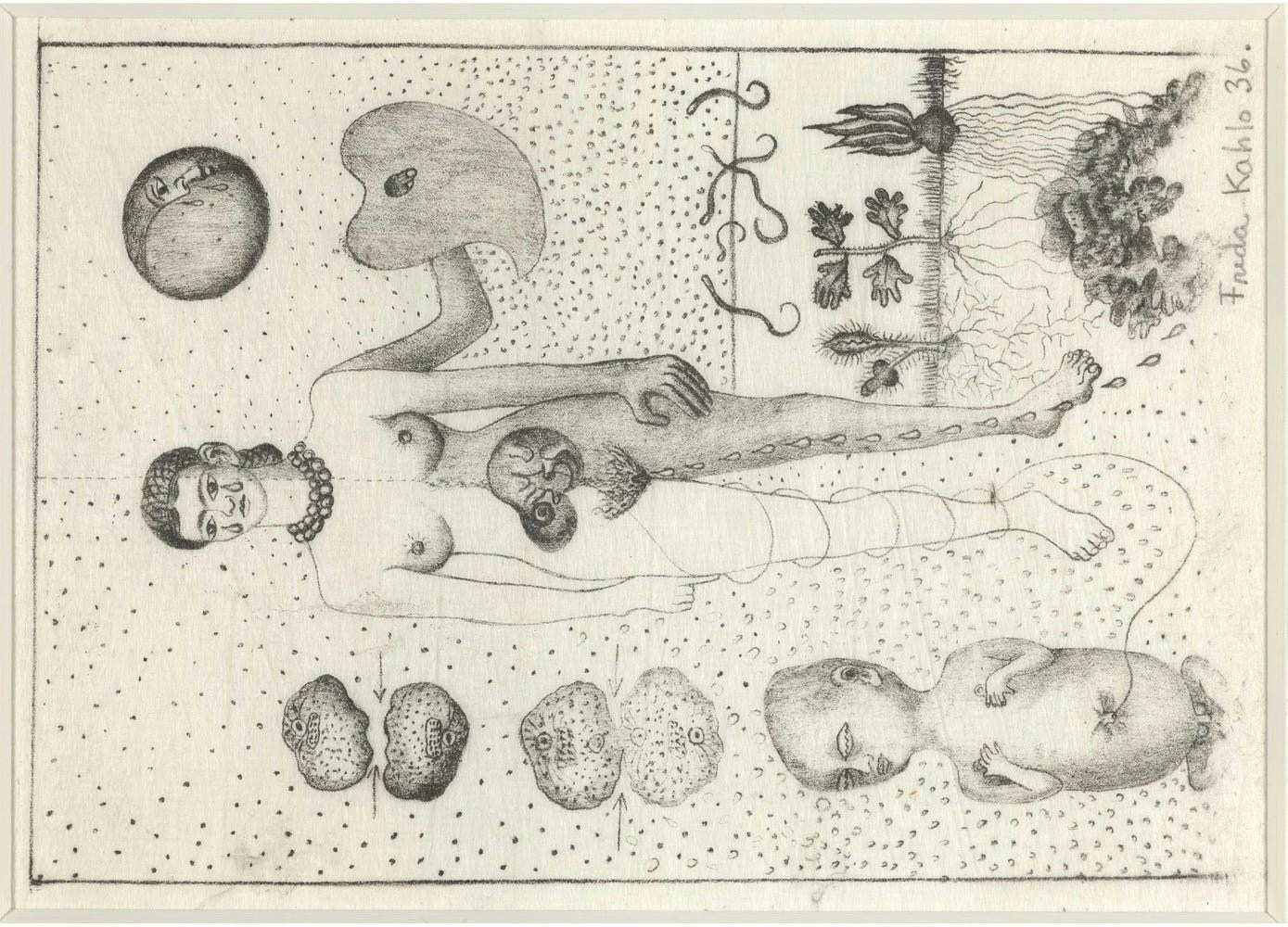
Image: Frida Kahlo, Frida and the Miscarriage, 1932. Lithograph.
When we found out I was pregnant, my husband told me we couldn’t get excited just yet. He had seen his friends go through miscarriages. I didn’t have that context because most of my friends hadn’t had kids yet. I got really mad when he said it because I thought he was being negative—I didn’t understand how common miscarriages were.
I was pregnant for one month, but it felt much longer. I bonded with the baby I thought I was having. I talked to it all the time. We had our appointment on November 3rd. I remember thinking, “Great! Two years of marriage, baby on the way.” I did a lot of mythologizing about this child because the baby was supposed to be due around my birthday in June.
And it’s important for people to know that with miscarriage, especially if it’s your first, you really do see them as your child. It’s complicated. I know there are broader conversations about early pregnancy and what it means, but when you want the baby, it’s your kid.
I knew something was wrong during the ultrasound because it was taking forever. The technician kept taking photos. Then she brought in her supervisor. She said she was still training and needed help with the machine, but I knew something was wrong. Then they said the doctor would come see us.
The first question the doctor asked was if we had a history of multiples in our family. I said no. My husband has multiples in his family, but through IVF. We hadn’t done any treatment. Nothing. That’s why they were so silent. She said, “We found four.”
Yes. Quadruplets.
The odds of conceiving spontaneous quadruplets are something like one in 700,000 to one in a million. And it happened on my first try getting pregnant. That’s insane. (I did play the lottery afterward and I lost, by the way.)
They were all measuring differently on the ultrasound screen. One was too big, three were too small. Multiples have a much higher rate of miscarriage throughout pregnancy. There are vanishing twins; it’s kind of a miracle when multiples make it at all.
Then the doctor said they didn’t find heartbeats. So the first bomb was: quadruplets. The second bomb: no heartbeats. It was so much to process. You’re having a baby! Wait actually, it’s four babies! But actually, there is no baby! It was such a mindfuck.
And then the worst part came: waiting two weeks. With a missed miscarriage, they make you wait to confirm that nothing has changed. They don’t want to intervene unless they’re certain it isn’t viable. So I had to wait, still technically pregnant. felt like an alien invasion. And by that point, I realized my symptoms had started fading. I’d been ravenous and queasy for weeks before, and suddenly, I wasn’t.
I know this sounds woo-woo, but the quadruplets came to me in a dream that night. There were four of them, sitting in little feeding chairs or something. One was turned away, and three were looking at me. They were boys. And one of them said, “We’re not coming. Don’t hold on to hope. It’s okay. We weren’t supposed to come.”
That was important because my husband was trying to stay optimistic. The doctor had indicated that it was possible two could survive, and two were definitely gone. Even that possibility felt like another nightmare. But because they told me they weren’t coming in this dream, I felt certain there would be no baby after that.
No one in my life had known I was pregnant. And no one knew I was miscarrying. Those two weeks were the worst of my life. I was carrying this secret. I was falling apart. My husband was falling apart. And we couldn’t tell anyone.
When we finally had the second ultrasound and it was confirmed nonviable, I felt relief. I could close the chapter and start healing emotionally. I was terrified of miscarrying quadruplets naturally.
I’d heard that miscarrying one was hard after obsessively scrolling Reddit and seeing multiple threads about it. Every doctor recommended a D&C, which I was fortunate to be able to access in New Jersey. I knew I couldn’t risk miscarrying naturally because of hemorrhaging or not passing everything and needing an emergency procedure. Miscarriages can be incredibly traumatic and I didn’t want to go through that physically with four.
The actual procedure of the D&C experience was, honestly, as good as it could have been. The hospital staff were kind. The doctor was wonderful. I could finally tell my family and friends, and I felt relieved to not be holding it alone anymore.
And then came a terrifying detail of the American healthcare system—you never know what anything will cost.
I arrived around 1 p.m. and left around 6 p.m. The surgery itself was about 15 minutes. The surgeon charged $1,800 and I honestly would’ve preferred to just hand her that directly. She was fantastic. Out of pocket, I owed her $60. The hospital portion I owed was $2,825. The anesthesiologist charged $367, which felt reasonable, because he put me under. I would’ve happily paid him directly too. But then there were all these additional charges: medications, line items that weren’t clearly explained.

"Altogether, the total billed amount across everything was $41,612.52. My insurance plan paid $9,918. I paid $3,434. And there’s this huge gap of money that I don’t fully understand. In total, I paid $3,434 to miscarry quadruplets."

I was stunned when I got the bill. I remember thinking, “I can’t believe I have to pay to have a miscarriage.”
I knew my deductible. I had chosen the cheaper insurance plan because I didn’t expect to get pregnant so quickly; I still don’t think that should be a reason to be punished financially. (I did learn my lesson and got the more expensive insurance the following year, but also, would it even have made a difference?) It felt humiliating and infuriating, an insult added to injury.
What am I paying insurance for? What are my taxes for? How are people supposed to have kids in this country? I shared the bill publicly because I wanted to raise awareness. Some people even suggested it would’ve been cheaper to leave the country for the procedure, which is absurd. That shouldn’t be the solution.
It’s confusing, it’s overwhelming, and it really does make you wonder how anyone is supposed to have kids in this system when everything is so unpredictable.
I called the hospital directly and told them we couldn’t pay for it. They gave me 20% off. That was it.
My husband had been contributing to an HSA through his insurance (we were on separate insurance plans at the time), and he’d been putting money away for a future baby. And then we had to use it for a miscarriage. Are you kidding me?
And calling insurance is traumatizing because you have to re-explain everything. It’s so demeaning. You’re reliving the worst thing that’s happened to you, talking to someone faceless on the phone who might say, “We can reduce it by $500.” It’s absurd.
And I hate knowing that in other countries this would have been free. I understand I’m privileged to even have insurance, but it’s hard not to analyze what you’re even paying for. They tell you, “Have kids.” Okay, how about you make it possible? The uncertainty is awful.
You’re waiting for the envelope, wondering what the number is going to be. And if someone else had the exact same procedure, they’d pay something completely different depending on their insurance. It’s arbitrary. And listen: I do want to have kids. I still want to. People tell me it’ll be more stressful now because I’ll worry about losing another pregnancy. But I already survived it once, so in a strange way, I know I could survive it again.
I’ve been trying to figure out if my experience was traumatic. The actual medical care was excellent. The doctors were kind. I felt safe. They really paid attention to me. They had never seen spontaneous quadruplets before, so in a strange way, I was this anomaly. So no: the physicality of it was more deeply awful than it was traumatizing. I realized I’m strong. I’m resilient. My husband and I grew closer. I’m not grateful it happened, but I am grateful that I know I can survive hard things.
What does feel truly traumatic is having your eyes opened to the American healthcare system in this way. It feels like being kicked when you’re down.
I don’t think anyone should have to pay thousands of dollars to lose a pregnancy. Hearing about people who pay to have stillbirths makes me physically ill. I know medical bills bankrupt people every day, and I’m lucky this was my first real encounter with it. It feels particularly humiliating to pay this much for a miscarriage.
The other scary part is that I might be a hyper-ovulator, meaning I release multiple eggs each cycle. This could happen again. I don’t want to get pregnant with quadruplets that don’t come to term, so I need to go to an IVF clinic to monitor my natural cycle. So far, this cycle looks like one egg, which is reassuring.
And guess what? I don’t know what this monitoring will cost! I don’t know how bitter the financial pill will be, though I would rather pay for peace of mind. I’m fortunate to be in a position where I can say that. I understand IVF and fertility care almost always come with costs.
I follow a lot of hyper-ovulators online. I’m in multiple multiples groups. There are women who’ve had twins, then triplets, then twins again, so it’s a real possibility. Theoretically, every time I get pregnant, it could happen. I have no idea.
But I do want kids. I’m still hopeful.