The Multigenerational Parenting Diary that Connects Me with my Ancestors
Words by Leah Bhabha
I always judged the block photoshoots. You know the ones: A dressed-up baby, freshly changed, bibbed, and burped, lying on a mat next to wooden cubes displaying their name and exact age. Out of the frame is the chaos of half-drunk bottles and burp cloths, the parents waggling a toy or singing a song to get the baby to stay still. The outtakes, I think, are always better than the ones inevitably posted on social media. Cloying captions are often addressed to the child, thanking them for choosing their parent and using euphemisms like ‘spirited’ to describe their personalities. Sometimes, they’re an ode to a partner, their hero, the best on the planet, the person that makes their family whole, that they ‘love doing life’ with. When I was pregnant, I vowed I’d never partake in these public tableaux. Even before giving birth, they felt like an artifice, a depiction of early parenthood that was unattainable and therefore false.
Now I can understand the urge to capture one’s children at every milestone, as they change and grow and bend our hearts, bodies, and brains into every shape imaginable. Of the almost 33,000 pictures on my phone spanning a decade and a half, my daughters probably feature in at least 80 if not 90 percent of them. I’ve photographed Matilda and Rio at every stage, from their most miniscule existences in utero (including when Rio was briefly one of two embryos inside my womb) to the walking, talking, demanding, loving people they are now, at ages five and two. When they do something adorable or funny, I feel an unshakable—even reflexive—urge to record it, to crystallize and preserve the moment for myself and, to be honest, show those I love. Over the last few years, my husband and I have kept a shared Note in our phones with funny quotes from Matilda. But I’ve kept track of their development in another way too.


"I always judged the block photoshoots. You know the ones: A dressed-up baby, freshly changed, bibbed, and burped, lying on a mat next to wooden cubes displaying their name and exact age. When I was pregnant, I vowed I’d never partake in these public tableaux. They felt like an artifice, a depiction of early parenthood that was unattainable and therefore false."

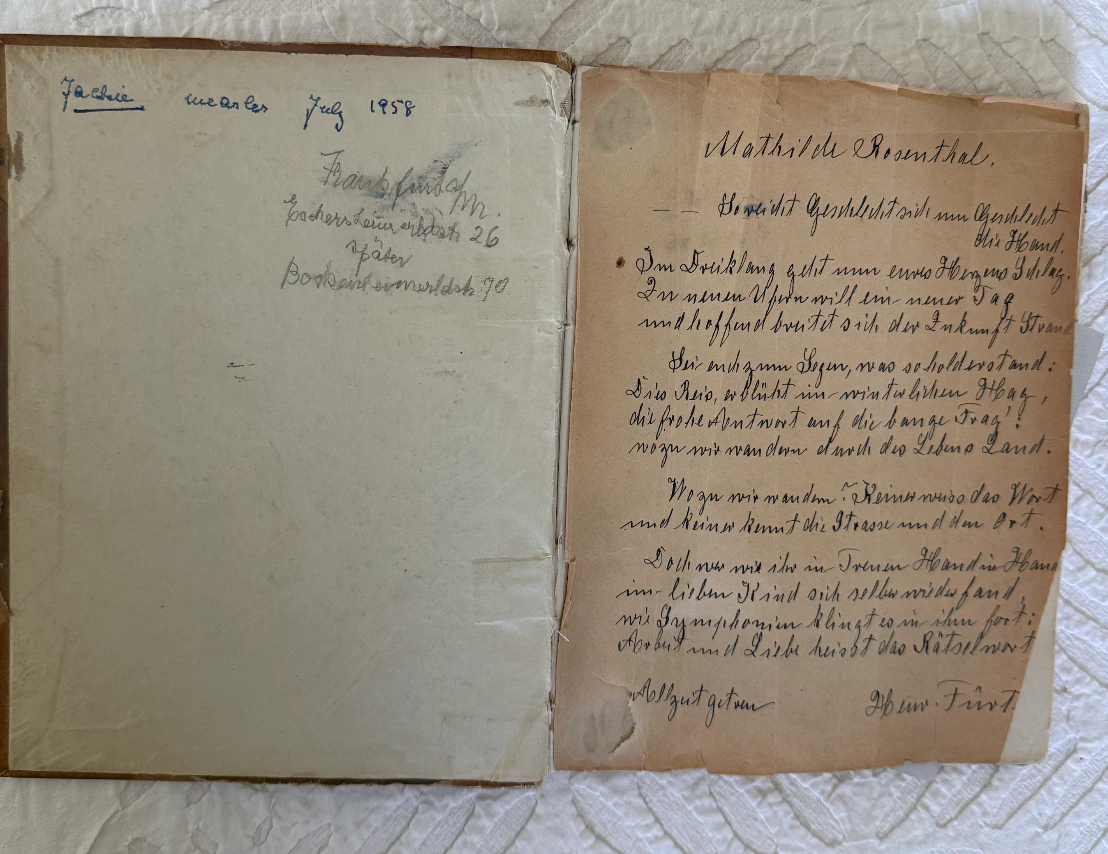
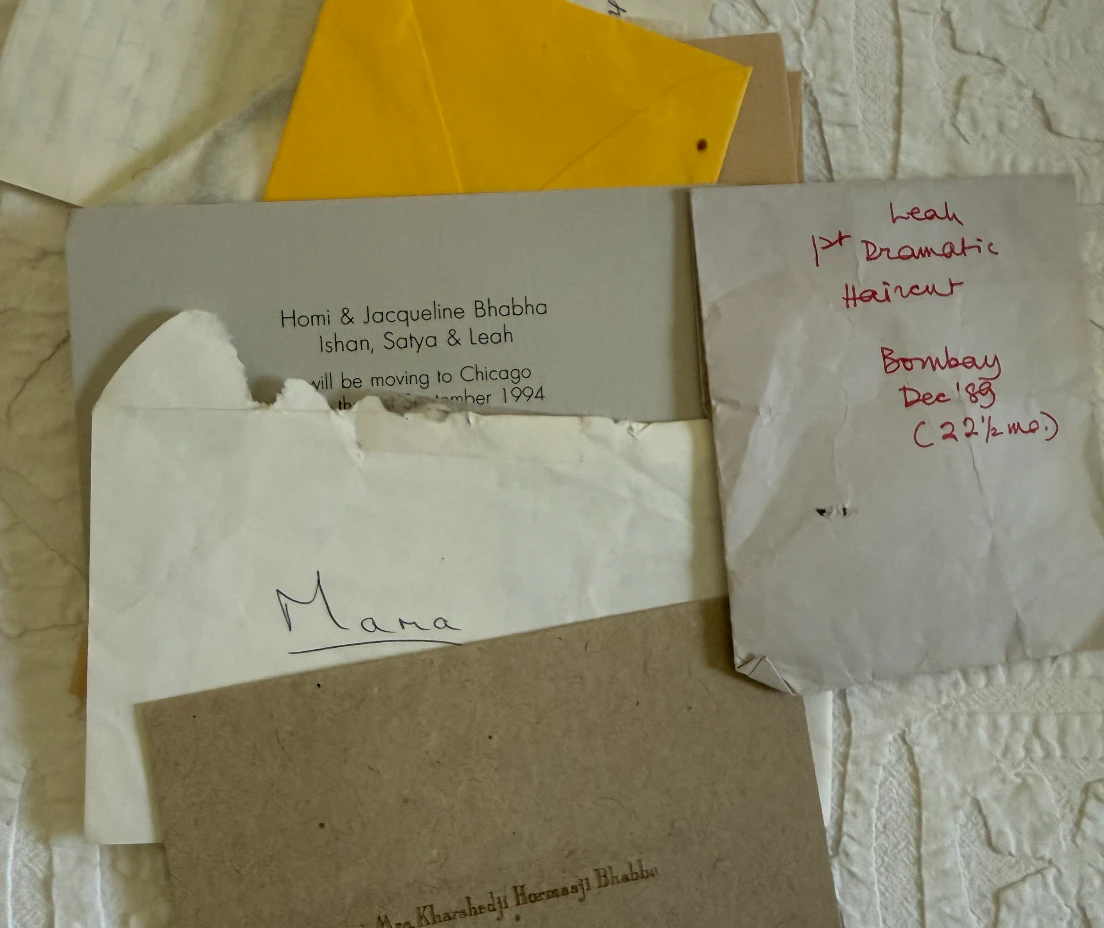
In the third trimester of my first pregnancy, my mother handed me a book. It was worn, with a threadbare cover and cracked leather spine. The sides were swollen as a result of many additions: pieces of folded tissue that had turned silky with age, yellowed envelopes, airmail letters, and envelopes of various provenances. “This is the book,” she told me, putting it into my hands with a warm squeeze, “where the women in our family, starting with my grandmother, wrote about their babies. Now it’s for you.”
First, I examined the artifacts which caused the book to bulge. From tissue nests, I unfurled hair trimmings—“Leah 1st Dramatic Haircut Bombay Dec ‘89 (22 ½ mo.)—and milk teeth, accompanied by notes written to the tooth fairy. I found a letter from my father to his grandmother-in-law and a change-of-address card printed ahead of our family’s 1996 move from London to Chicago. I transferred many of these addendums to a Ziploc bag for safekeeping, then opened the cover once more to read its contents. On the first page was the name Mathilde. The book began with her, my mother’s mother, written in Germany by her own mother, Nora. By this point, we had already decided to name our daughter Matilda (the spelling altered to avoid mispronunciations). Encountering the first accounts of her namesake-to-be 99 years before made my breath catch.
The familiarity of my mother’s handwriting and my own vain curiosity shepherded me to the pages about my siblings and me. In great detail, she wrote about my eldest brother, Ishan, and his first days and weeks. As she often forgets details of our childhood, these entries provided me with a primary source, an undeniable record. Though she had commiserated when it took me longer than I’d hoped to get pregnant, saying that conceiving Ishan had also taken time, the text disagreed. “Well, it all happened rather quickly, Ishan must have been conceived sometime around the beginning of May—we had only started ‘trying’ the month before.” The sections about my other brother Satya’s birth were far less in-depth than Ishan’s (with more children comes less time to opine about them, I suppose), though I found a page of digits written in my father’s hand. They were, I realized, the specific timing of my mother’s contractions, the minutes getting closer and closer until…
The first entry I feature in, I am three months old. “Leah, or Leahli as we call her, (and Soozi as she was called by the boys for the first month or so) is already three months old. She is a delightful baby who has a punk hairstyle, wavy brown hair flecked with gold streaks on top of her head…ravishing smile which lights up her whole face, rather solemn grey/brown eyes, and lots of folds round the top of her legs and about her wrists.” I continued to read, the entries growing farther apart until the last one in 1992, written when I was four. I can’t fault my mother for the omissions, now knowing the hectic pace of two small children, I can’t imagine the frenzied tempo of three. Her words are comforting and tender, giving context to the early period of our lives, which she also memorialized in photo albums dutifully made for each of us through high school. Relics from a time when pictures were physical objects kept in your house, for only visitors and inhabitants to see, not identity clues constructed for strangers to pore over.


As I’ve thought more about the block photo shoots, my attitude has softened. Maybe they’re not simply about parents showing off their children. These portraits are a way for exhausted people to claim the passage of time, especially when some days can feel like a Herculean effort—their soft lighting and props placed just so clearly belying a carnival of emotions and chaos. They’re nostalgia-laced proof, a version of honesty without candor, a snapshot determined by a specific number of days or weeks or months.
When Matilda was born, I was obsessive about the numerical details, how many milliliters of colostrum and then milk, pounds, ounces, percentiles. Numbers provided something to focus on when almost nothing made sense, when my brain and body were spaghetti and I wondered if and when this would become second nature. My hours were wholly taken over by this tiny little being, but every vitamin D drop and soiled diaper was a data point I could count on. Getting myself showered and her dressed were reminders that I could do it, I could be in this new existence, the new truth of my life.
I’ve found that early motherhood is, in essence, a paradox. It’s a sublime mess of bone-crushingly deep adoration and care, worry and guilt, disorder and thanklessness, comfort and closeness, monotony and surprise. It’s the end of selfishness, the mornings that start without warning, no matter the day of the week or the previous night’s activities. It is peanut butter-crusted meals ruptured by outbursts over utensils, bibs, and shoes. It is feeling like the people you love most are trying to hurt you even if they don’t know it. It is alternately deep relief and talking yourself out of jealousy when they reach for someone else. It is knowing it’s immature to sulk with a four year-old who has screamed at you and is now draping their entire weight onto your body. But it’s also carrying them, when they’re begging for Mama and having them melt into your lap. It’s hearing new words uttered that you didn’t know they knew. It is the unfettered joy of watching them giggle uncontrollably or teach you something or love the books that you loved as a kid. It is a bottomless well that can't be contained in platitudes, captions, or photo shoots.
So, can I blame anyone for the way they portray their child, for wanting to hold onto the sublime, smiling moments and display them proudly or refer to them privately when things feel wobbly or downright broken beneath their feet? Can I fault the performative birthday posts, addressed to children who can’t see them, displaying balloon arches with heartfelt messages and star emojis?

"In the third trimester of my first pregnancy, my mother handed me a book. It was worn, the sides swollen [from] pieces of folded tissue that had turned silky with age, yellowed envelopes, airmail letters, and envelopes of various provenances. 'This is the book where the women in our family, starting with my grandmother, wrote about their babies. Now it’s for you.' How had I never heard about it?"
As I packed my hospital bag a week or so before giving birth, I carefully placed the book first, in a Ziploc to avoid contact with toiletries or the innumerable nipple balms and creams I’d soon become acquainted with. Many hours later, as Matilda lay swaddled in her isolette, one day old, I began to write. “My darling Matilda was born at 9:21 AM yesterday, August 6th at New York Presbyterian Hospital in downtown Manhattan.”
The symmetry of this heirloom, which began with a Mathilde and was gaining another one, felt otherworldly. Births had been recorded in four different countries, my grandmother’s in Germany, my mother’s in India, mine in England, and now my daughter’s in the United States. The book had escaped Nazi Germany tucked hastily into a bag, telling the stories of a person born into a place that soon decided she shouldn’t exist and didn’t belong. And here it was, telling the story of a new baby girl, inextricably connected to the women who came before her, only two of whom she would ever meet. The symmetry was present also in the three generations of oldest sisters, a chain broken temporarily by my older brothers. Like me, these three women were all writers. Nora, my great-grandmother, wrote a memoir about her life as a war refugee, Mathilde diaried copiously and published an academic paper, and my mother Jacqueline has authored several books in her fields of human rights and child migration. And here, we connected through our writing in a tactile way—my pen imprinting into their pages, the oils from our hands mingling many decades apart. Did they write at night, I wondered, after bedtime stories and teeth brushing? Was it when they had childcare or a spare hour during naptime?
As I wrote about Matilda’s newest developments—her first words and favorite foods—I explored the original Mathilde’s impressions from the early days of her daughter, my mother. “Our little Jacqueline is becoming a real person,” my grandmother wrote on August 23rd, 1951, when my mother was seven weeks old. Mathilde charts her daughter’s growth and development assiduously, recording inches and vaccinations, and physical milestones. And yet one feels a sense of remove, an emotional distance: “At 22 months, Jackie has all her teeth and quite a fair vocabulary…She likes to be with other children but is inclined to treat them roughly. She is very self-conscious. The bigger the audience, the more she likes to show off.” She seems troubled by her daughter’s need for attention, is a classic marker of toddlerhood not, as she appears to suggest, a character flaw. “Two years and 1½ months, Jackie has at last learned to occupy herself alone.” Just two years old! She compliments my mother’s courage at the doctor, but not without undercutting it. “Jackie is capable of great bravery when her pain or accident entails action and attention of many people.”


It is a strange sensation to feel protective of my mother as an infant and judgmental of the grandmother I never knew. (Even calling her my grandmother feels false, as if I’m fabricating a relationship with someone who died years before my birth). And yet I do feel protective and judgmental, wanting to kiss and cuddle this little tow-headed, chubby infant I know from black and white pictures and shake my head with some disdain at her mother. The adjectives used—irritating, stubborn, show-off—don’t square with any facet of my mother as I know her, but simply with a young child learning and testing boundaries as she sees her life upended by the arrival of a younger brother. It contrasts so deeply with the tone my grandmother used about her son. “At 2 ¾, Oliver is a pure joy.” Of course, childrearing is profoundly challenging and children are often self-absorbed, needy, dramatic, irascible. But I couldn’t help feeling that this dynamic was viewed through a lens of disapproval and favoritism.
I’m aware of projecting what I have heard from my parents about Mathilde. I know she was difficult, but her childhood had been riddled with trauma, how could that not have affected her character? I know she didn’t like my father and always favored my uncle over my mother. I know she was strident in her beliefs, opinionated, and very serious, with no patience for jokes or frivolity. What would she think of me? And of her affectionate, sensitive, and gregarious namesake? I’ve always known that the relationship I have with my mother—primally close, multiple phone calls a day, her advice on everything—is in spite of the one she had with Mathilde.
When I first began this essay, Matilda was 2 ½, half the age she is now. Her sister was not yet a speck on the horizon, today she is two. Though I wish I didn’t, I feel bad about how little I’ve written about them, especially Rio. A few pages here and there. But in between the camp sign-ups, the work meetings, the bubble baths, the school drop-offs, and the grocery carts, it’s an afterthought, another avenue of guilt to lead myself down in quieter moments. But I have written and will continue to, even though the time lapses may grow as the girls do. I’ve added sonogram pictures, hospital bracelets, and even the small blue square of lead Rio used for a chest X-Ray on her first day of life. Those time lapses are life lived, not missed opportunities.
I wonder when my own daughters will encounter the book. Will they open the pages in the cold, institutional air of the hospital, hormones flooding their bloodstreams, a tiny new being, part of our indelible chain, lying alongside? Will handwritten books feel alien to them? Will they read about their own births or start with their grandmother or great-grandmother, or great-great-grandmother’s words? Will I be sitting beside them? Will they turn the pages together or apart? Will I be able to wait, as my mother did, to share it with them? And, being the first in the line of two sisters, how will they share the book? Will they pass it back and forth? Will they both have babies? Whatever this artifact becomes to my precious girls—whether it remains just that, a delicate artifact in a time of technology, or continues to be a living, breathing source of reflection and insight, I know it will endure, a powerful testament to the travails and delights of motherhood.
Leah Bhabha is a writer and content strategist. She writes the Substack Leah BlahBlah and has contributed to publications like Vogue, New York Magazine, and Bon Appétit. She lives in Concord, Massachusetts with her husband and two daughters.