
So Are We All Fixing Our Vaginas Now?
Words by Jeanine Celeste Pang
The first time my vagina appeared on a widescreen monitor, it was presented as a problem to solve.
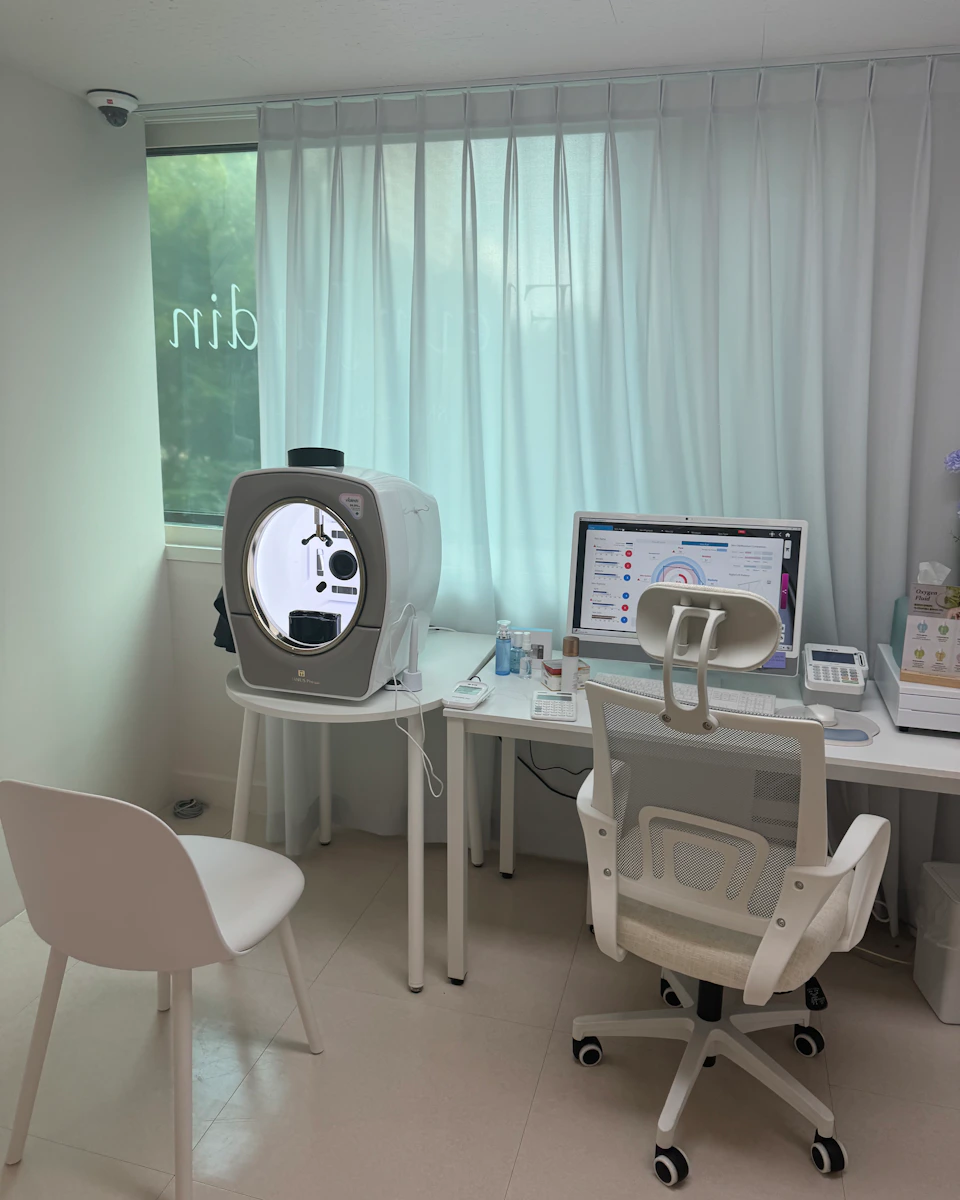
I was at a women’s OB-GYN health clinic in Gangnam, Seoul for what was described as a standard gynecological consultation with the head doctor. Twenty minutes prior, I was reclined on my back, limbs splayed in that familiar, vaguely undignified way, fidgeting with the hem of a borrowed skirt. Everything felt routine—except for a few small deviations.
First, there was a medical assistant, quietly taking close-ups of my vulva on an iPhone.
Then, the doctor added another layer to the exam, testing my pelvic strength with her latexed finger and instructing me to perform kegels. I squeezed hard. “Hmmm,” she murmured. “Not bad. But you should be doing them daily. ”
After getting dressed, I sat across from her desk as she began her speech. Queued up on the computer monitor were enlarged post-op images of what she called “the ideal.” She hovered the cursor to emphasize her remarks: See how full the labia majora, how slim and symmetrical the labia minora, the position of the clitoral hood, the brightness, the smoothness, as if she were teaching a class, and these were her diagrams.
And because she was the instructor, she graded mine.



"The first time my vagina appeared on a widescreen monitor, it was presented as a problem to solve."
The desired aesthetic was a 1 or a 2. Anything between a 5 and 6 required immediate attention. She placed mine at a 3 or 4. She toggled between “the ideal” and my own with the ease of someone flipping through before-and-afters, pointing out where I could improve in symmetry and shape, texture and tone. As if any deviation were an error. “Is this your work?” I asked. She nodded proudly.
For the next 20 minutes, we discussed options that had never entered my mind. She ticked off a stack of same-day treatments, including fractional lasers for brightening; biostimulators for volume; and fillers and high-frequency machines for tighter inner walls. And oh, did I want to perk up my nipples while we’re here?


“Come back for a labiaplasty next time you’re in Korea,” she said, telling me that the surgery itself was done in under an hour with minimal downtime and barely detectable scars. (The clinic performs an average of three per week.)
The most unsettling part was not that all this was offered, but how quickly it began to sound reasonable. I’ve never been the type to take a mirror to my vagina or give it a pet name. It existed the way most internal things do, with its own private rhythm, outside the realm of aesthetic tweakage except for the occasional bikini wax. It had performed its womanly duties—created life and recovered as best it could. Somewhere in the postpartum recovery it stopped belonging to me, becoming a thing made for function. Besides, I had other body parts to prioritize. My waning breasts, for example. Or the shar pei skin on my stomach after birthing twins. Or just—the face.
But sitting there, with a binder of menu options in my lap, the vagina moved to the top of the list. The potential of a rebirth woke it up, nudged by competing choruses: “You deserve this, you exhausted desexualized mother” versus “Have you lost your mind, don’t cave to some ridiculous beauty standard.”
I ended up staying at the clinic for another two hours, opting for less invasive treatments, including lasers for toning and collagen-stimulating injections. It felt good to have this private—and powerful—part cared for. After poking and zapping, the doctor gave my labia a brisk massage with a plant-based “estrogen” cream. “Do this twice a day, two minutes, and always firm and directed up,” she said, demonstrating in real time.
When I asked how long I was meant to keep up with the massaging and cream, she didn’t pause. “Like your skincare,” she said. “Until the day you die.”
Once she was done—and while I was still reclined half-naked in the operating chair—she held the office iPhone close to my face and pulled up photos of my new and improved. I squinted. It did appear slightly pinker, more flushed, more alive. “It looks pretty,” I said. I felt like I was staring at a post-facial glow. Me, but better.
If this all felt weirdly inevitable, it’s because it was designed to be.
"It’s no longer whether something looks 'wrong,' but whether it’s one more thing to fix. And for women post-childbirth, that fixing arrives when we may be least able to resist it. "

Globally, vaginal rejuvenation has quietly become one of the fastest-growing elective procedures—no longer fringe, but increasingly standard. In Seoul, with the highest plastic surgery rates per capita in the world, this kind of care exists at the intersection of medicine, aesthetics, and wellness. Clinics, with their embroidered robes, social media lighting, and private recovery rooms, operate more like high-end med spas. Extensive treatment menus that might otherwise be considered vanity elsewhere are offered like necessity—framed as confidence, even wellbeing—applied to any part that doesn’t fit “the ideal.”
For example, the clinic’s website describes a “deformed” labia minora as something that can cause discomfort in daily life, warning that, if left untreated, may worsen over time: “It is recommended you consult a professional as soon as possible.”
Within that logic, the question shifts. It’s no longer whether something looks “wrong,” but whether it’s one more thing to fix. And for women post-childbirth, that fixing arrives when we may be least able to resist it.
Pregnancy and childbirth already reorganize the form into something foreign—stretched, softened, marked by function. At a time when mothers are vulnerable, sleep-deprived, and wondering if it’s time to start hormone replacement therapy, entire industries exist to guide us back toward a version of ourselves with language like bounce back, tighten, and restore. Or ominously: Feel like yourself again. (Sometimes I think if I tried to bounce back any harder, I would ricochet out of my body and into a stranger’s.)


"Globally, vaginal rejuvenation has quietly become one of the fastest-growing elective procedures—no longer fringe, but increasingly standard."
My shelves brim with serums and creams, supplements and tinctures, tools and devices, multiplying with every ad I'm served. I fly to Korea for medical tourism, with my favorite clinics for stem cells IV drips and salmon DNA injectables bookmarked in an Instagram folder. I know how this works. I participate. But after much of my adult life, it’s hard to tell where the system ends and I begin.
That evening, I had dinner with a girlfriend. Over a platter of raw oysters, I told her about the appointment. “Would anyone care? Who would see it, anyway?” I asked.
“You would,” she said, holding her shell mid-air. “You would know you had the perfect oyster.”

Months after the trip, I keep circling this idea of “perfect.” Not just something imposed, but something I recognized—and unsettling, desired. Perfection doesn’t suddenly appear. It expands into whatever parts of your psyche you let it touch.
I’d like to believe there are still places exempt from that logic. Places allowed to simply exist—wild, sacred, enough. My daughter, who tells everyone she is six, talks about her body brightly, entirely her own. She steps out of the bath wiggling and dancing with such confidence that I wish I could bottle it up and return it to her one day. I would never want her body to become something she learns to measure or watch from the outside. My mother, who will not disclose her age, taught me early that beauty was currency, and she knew how to spend it. When I was ten, she handed me my first bottle of lactic acid to be tapped nightly over the face (the same one she used). “You look like me,” she would often say, which meant I had something worth protecting. The lesson landed before I had language for it.
I’m grateful the options exist. I’m just not sure what it means that I came to want them—or how far the wanting goes.
Jeanine Celeste Pang (@jcpthatsme) is a writer and narrative strategist whose work has appeared in Vogue, CNN, T Magazine, W Magazine, and Refinery29, and most recently led brand voice at Old Navy. She lives in Berkeley with her twins, and her first children’s book is out this fall.