
Apple Will Help You Track Your Perimenopause Symptoms
It's not an understatement to say that our growing reliance on technology can be scary—in fact, this may be the understatement of the century. But when companies make waves to actually improve our lives, especially around our health, recognizing our womanhood in all its complexity in that process, well—we must salute.
Despite affecting approximately half the world's population, perimenopause and menopause have long been under-researched, misunderstood, and stigmatized. But Apple announced at its WWDC 26 in June that the Health app would be able to help you track and identify symptoms of perimenopause and menopause. In addition, it’ll offer a Fitness+ program specifically designed for perimenopausal and menopausal women.
If you’re wondering if this is you, remember perimenopause typically begins in your mid-forties but can occur as early as age 37. (The Cut ran a super-informative article, entitled “Is This Perimenopause or Postpartum?”, which is required reading for those of us in the above age buckets.)
Spread The Jelly's co-founder Lauren Levinger got to attend WWDC 26, which led to an immensely interesting conversation with Dr. Lauren Chung, the head of health products at Apple and assistant professor of medicine at Stanford Medicine, and Julz Arney, senior director of fitness at Apple.
Below they spoke about how cycle tracking can help us understand our own bodies and address symptoms before they interfere in our life, why they believe this phase of our life must be studied and invested in, and the ways in which data privacy around women's health is so important to Apple.
(This new update will be available in the fall. )


We are excited for our perimenopausal and menopausal community to have this new technology readily available on our phones. Tell us about the new tracking.
Dr. Lauren Chung: We've designed the health ecosystem to meet people where they are throughout every stage of life. That means helping turn health information into meaningful insights they can better understand and act on. We do that because we believe everyone deserves powerful, personalized health tools. We have a track record of focusing on health needs that have been overlooked and building thoughtful solutions to address those areas, whether that's fall risk, hearing health, heart rhythm notifications, and more.
Cycle tracking is obviously one of those areas as well, which is a feature that grows with you—from logging a first period to family building to pregnancy to ongoing health awareness. What we're excited about is that now we're able to extend that continuity into perimenopause and menopause which affects roughly half the world population, but has historically been under-researched, misunderstood, and often stigmatized.
Users can now log whether they're in perimenopause or menopause and can track symptoms and monitor their cycles over time. We've also added educational articles into the Health app on perimenopause and menopause because it's a subject that is very poorly understood. We want to make sure that our users better understand this new chapter and offer educational articles also offer tips to better manage it, and all of them have been informed by our clinical experts.
Now, for users who log bleeding after menopause, which is something that is not normal, they'll receive a notification to speak with their doctor. For users over 40, they can receive a notification if a deviation in their logged cycles is suggestive of perimenopause, which allows them to take action earlier and have more informed conversations with their doctors.

"What we're excited about is that now we're able to extend that continuity into perimenopause and menopause which affects roughly half the world population, but has historically been under-researched, misunderstood, and often stigmatized."
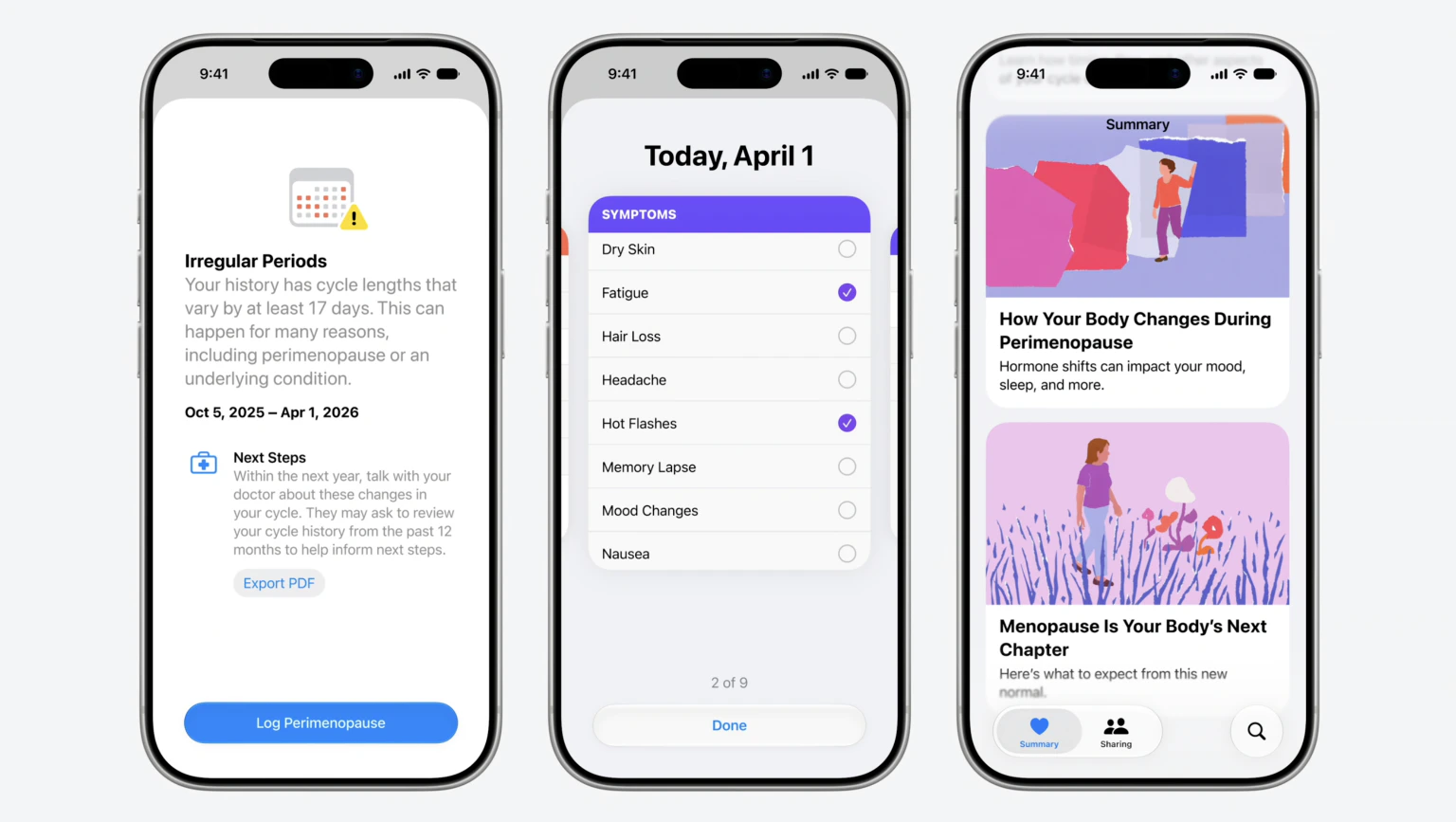
Women's health has been so underserved in so many ways, and we've really been dedicated and passionate about how we can just bring more awareness to this space and really help women along their journey better understand what's going on in their bodies. I think that's critical to feeling good every single day about who you are and what you're going through. We encourage everyone to track their cycles. It helps us understand their health better, and the educational articles are an excellent way to learn about aspects of health that have not been talked about a lot.
And what does the Fitness+ component look like? [Ed. note: the Fitness+ program is already available.]
Julz Arney: I'm super excited to talk about our new "Strong Through Menopause" program that we have dropped in the Fitness+ service, because staying active is one of the most powerful things you can do for your body and mind during this transition. So we really wanted to make sure we were showing up for users by giving them a workout plan that can help perimenopause and menopause be a smoother ride and help you feel more like yourself through it.
So, at Fitness+ and especially at Apple, we've always believed that fitness should be accessible and welcoming for everyone. So when we were creating this program, we were looking at what users actually need. There's a lot out there around perimenopause and menopause, and what we landed on is that when it comes to fitness in this season of life, it's less about performance metrics, and it's about resilience. It's about finding ways to protect your health, to feel strong and, like I mentioned, more like yourself.
It's built around yoga and strength training, approachable workout styles that also support pelvic floor health, overall muscle strength, and even cardiovascular health. So um we're just really excited to support even more users to get and stay active, which is exactly what Fitness+ was made for.
Why make this investment in this stage and in women’s health research as a whole?
Dr. Lauren: These features build on Apple's long-standing investment in women's health research and they've been developed in-house with our clinical experts who understand the unique needs of this life stage.
Perimenopause and menopause can impact so many aspects of health, including sleep, stress, and anxiety, and overall well-being. During this phase of life, women's risk for diseases like cardiovascular disease increase dramatically. So regular movement and strength-focused fitness can help support both physical and mental health during this transition.
This stage of life has been so under-studied in the past. Now I think science is starting to uncover that our exhaustion or brain fog isn't just because we're moms and we have kids that we're trying to manage in a household. They are actually pathologic things. Some of the stuff that happens during that phase is starting to be better documented.
We're finding that anxiety ramps up very heavily in this stage of life as well. One might attribute that to parenthood, but actually we're finding that there are some relationships to it that are separate from being a parent. [Through our own studies and investments in women’s health] we're hoping to uncover new scientific discoveries about this phase of life with that as well.
"Perimenopause and menopause can impact so many aspects of health, including sleep, stress, and anxiety, and overall well-being."

How does the research you guys do impact the Fitness+ directives?
Julz: We bake the clinical findings into our program. Bone health is one that you're thinking about during this part of your life, and strength training is a great way to build bone health. It’s a very preventative health measure that you can find just by working out 20 minutes a couple times a week.
We're just trying to make it a one-stop shop for everything that you might want to do to maintain your fitness while you're in perimenopause or or all the way into menopause.
Since Roe was overturned, privacy with regard to cycle-tracking can be a massive issue in states that have criminalized women's health. Where does your team stand on that?
Dr. Lauren: When it comes to privacy, we do believe that privacy is a fundamental human right. There's probably no data that's more sensitive than your health information, and so we take it very seriously. We believe that our users should expect the same level of confidentiality from their technology as they do their doctor, and we treat that information that way.
All of our features, including our fitness features, are built from the ground up with privacy in mind. What that means is that if anyone has their passcode, Face ID, or Touch ID activated, all of their information is encrypted on-device. Now, if they have the default two-factor authentication enabled and are backing up to the cloud, it's also encrypted while in transit to servers and while on our servers. So that means that Apple actually can't access that information in any way, shape, or form. We also don't provide anyone's information to any third parties. That data really is yours and yours alone. We believe it is yours to do whatever you want with it, and that is why we've also created granular controls where users can choose which third-party apps they want to share information with and exactly which information they share it with.