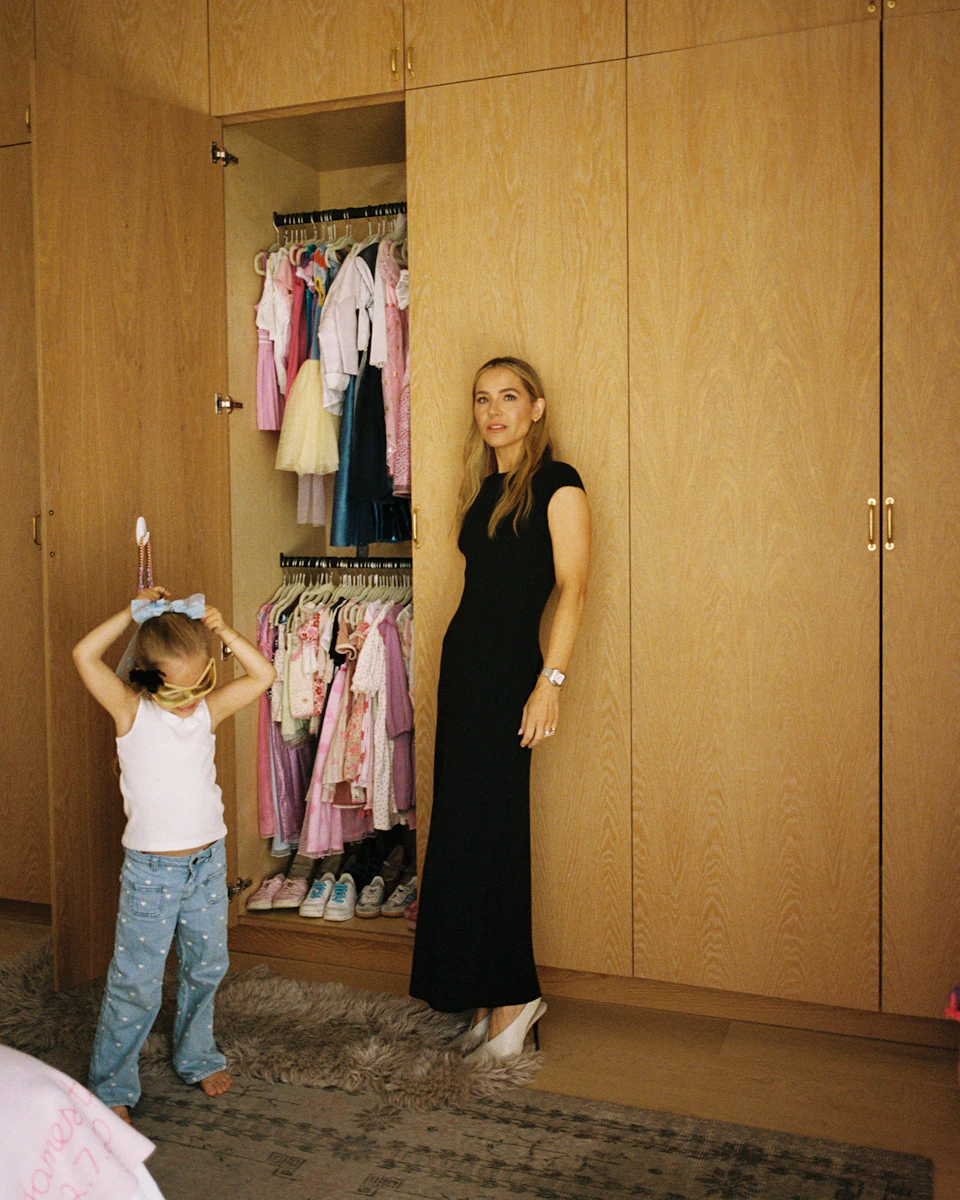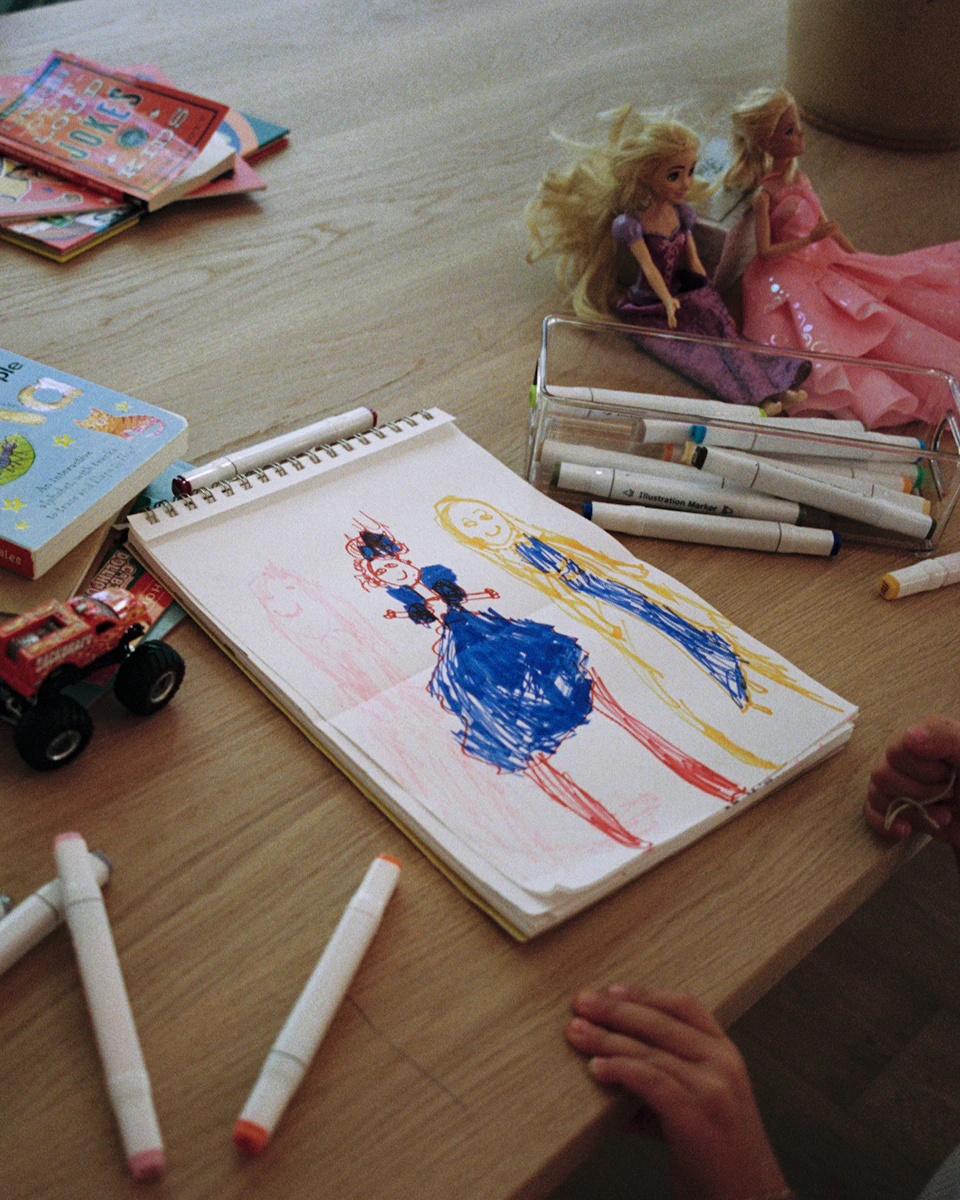
Getting Sticky with Alex Taylor
Brilliant, civic-minded, and impeccably chic, Alex Taylor, the co-founder of Perelel, may be polished but she’s not one to mince words. A mom of two, she’s running one of the most innovative wellness companies while advocating in D.C. for an increase in funding for women’s health.
Before all that, she was an almost casualty of the girl boss era, cutting her teeth at Vogue, Who What Wear, and Free People. She worked long hours, prioritized work above all else, and the week she made Forbes 30 Under 30, she broke out into shingles. The subsequent health challenges and very strange symptoms lead to an autoimmune disorder diagnosis. This experience navigating her own treatment birthed the idea of Perelel: creating research-backed vitamins dedicated to supporting women throughout the prenatal, postpartum, and menopausal periods.
Below she talks about her bout with postpartum anxiety, why accepting support was painful at first—read: she had a, self-described "Supermom complex"—and why the fight to equalize women’s health funding has only just begun.
Words by Emily Barasch. Images by Lindsay Molk.



"I had allowed my job to take priority over my health, and there was no way to undo the consequences."
This girl boss is tired
When I was a young executive, I had an incredibly demanding job. I was the president of a large company at a young age. I like to joke that I was "girl bossing" a little too hard. I was the woman waking up at 5:30 a.m., drinking my lemon water, and heading to SoulCycle. I lived a very high-cortisol lifestyle. I was the first one in and the last one out every day. I put my job before everything else in my life, and I've since learned that's simply not sustainable. No job is worth sacrificing your health. Life has a way of forcing you to confront what really matters.
Ironically, the same week I was honored on the Forbes 30 Under 30 list, I broke out in shingles. After that, I experienced a cascade of unexplained health issues–from my hair falling out to extreme lethargy. Over the following year, I saw countless doctors trying to understand what was happening in my body. Eventually, I was diagnosed with an autoimmune disease and a thyroid condition, both of which were likely stress-induced. In many ways, I felt like I had done this to myself.
That was one of the most profound moments of my life. I had allowed my job to take priority over my health, and there was no way to undo the consequences. My diagnosis would ultimately affect my fertility as I was trying to start a family, and it went on to shape my pregnancy, postpartum journey, and so much of what came afterward. There was no going back.

The women’s health research gap is always personal
A few realizations became instantly clear in that moment. I realized, first, how privileged I am. I'm a white woman living on the west side of Los Angeles with access to excellent healthcare, and I'm deeply aware of that privilege. Yet even with every advantage, it still took me a year to get answers. It was frustrating, confusing, and incredibly isolating.
As I dug deeper, I learned that roughly 80 percent of autoimmune diseases affect women. I also discovered the women's health research gap. For decades, women of childbearing potential were largely excluded from clinical trials, and that has had lasting consequences.
Much of what we know about human health has historically been based on studying men. The result is that women are often diagnosed later across hundreds of diseases because we simply haven't invested enough in understanding women's bodies. My story wasn't unique. The same challenges exist for women navigating autoimmune disease, heart disease, Alzheimer's, fertility, and so many other conditions. The fact that we still use the term "unexplained infertility" says a lot about how much we still have to learn.
That experience fundamentally changed my perspective. It shaped my sense of purpose and the work I wanted to do next. As I learned to manage my autoimmune disease, I had to take medication, change my lifestyle, and figure out how to reduce stress—which is much easier said than done.
I also turned to supplementation. Every member of my care team–from my endocrinologist and OB-GYN to my functional medicine doctor and acupuncturist–recommended it as part of my treatment plan. But putting together the right routine felt incredibly overwhelming. I'd stand in the supplement aisle staring at dozens of bottles, wondering why I was expected to piece it all together myself. It felt confusing and fragmented.
As I moved through my fertility journey, my supplement routine changed again based on where I was in life. I had an incredible care team guiding me, but that experience led me to connect with the woman who would later become my Perelel co-founder. We kept coming back to the same question: If our bodies and nutritional needs change throughout every stage of life, why aren't our vitamin routines designed to change with them? Why wasn't there a comprehensive system built by the doctors and experts who understand those transitions best?


Doctors do know best
At Perelel, we're deeply committed to making sure every formulation is backed by robust clinical research as well as the real-world expertise of our physicians. What's unique about our approach is that every ingredient has to earn its place. It needs to be supported by a strong body of clinical research, but that's only part of the equation.
Our physicians are actively practicing doctors, and that's an important distinction. They're working with patients every day, reviewing lab work, tracking symptoms, and seeing firsthand how people respond to different nutrients and dosages. They know what works in practice, what patients tolerate well, and where adjustments need to be made. That combination of rigorous scientific evidence and real clinical experience gives us an incredibly rich, human-centered perspective when we develop our formulations.
Forget immediate bounce back, try a seven-year claw back
Motherhood has been the most profound identity shift of my life. It changed the way I see everything–from my work and my priorities to my relationship with time itself. Before kids, my life was very achievement-oriented. After becoming a mother, it became much more purpose-oriented. Success stopped being about simply building something; it became about building something meaningful enough to make the world a little better.
I'll never forget looking in the mirror after having my first child and thinking, Who is she? I didn't recognize the woman looking back at me, and I wondered if I'd ever feel like my old self again.
Now, seven years into motherhood, I realize it was never about bouncing back; it was about clawing back. Over time, I've reclaimed the parts of myself that mattered most while also growing into someone entirely new. I've rediscovered pieces of my identity, but I've also uncovered strengths and parts of myself I never knew existed.
Motherhood has made my world smaller, but in the most beautiful way, because it's made my purpose bigger and sharpened my focus.
"Motherhood has made my world smaller, but in the most beautiful way, because it's made my purpose bigger and sharpened my focus."

Matrescence, ever heard of it?
Postpartum was a minefield of shock and awe. There was the physical recovery, of course, but also the profound psychological transition that comes with becoming a mother–a process known as matrescence. It's an enormous shift, affecting not just your body but your identity, your brain, and the way you experience the world. Even though the term was coined decades ago, it wasn't part of the mainstream conversation when I had my first child seven years ago. One of the beautiful things about the Internet today is that we're finally putting language to experiences so many women have been navigating quietly.
We spend months preparing for birth, but very little time preparing for what comes after. I was shocked by how quickly the support system seemed to disappear once my baby arrived. During pregnancy, you're surrounded by regular medical care, and then postpartum often feels surprisingly unstructured. You have your six-week checkup, and in many ways you're expected to simply move on. I remember talking with our medical co-founder, Dr. Bayati, and being struck by how long postpartum recovery can actually take. It reinforced something I was already feeling: recovery doesn't end after six weeks.
Pregnancy and childbirth place an extraordinary demand on the body. Recovery is complex, hormones are shifting, nutrient stores are rebuilding, and every woman is adjusting physically and emotionally in her own way. That disconnect made me realize just how overlooked and underfunded women's health–especially postpartum care–has been for far too long. We ask so much of new parents while often providing too little support, whether that's paid leave, access to care, insurance coverage, or simply the resources that allow families to adjust during one of the biggest transitions of their lives.
It was also a deeply personal journey for me. I experienced postpartum anxiety, something I'd barely heard anyone talk about at the time. I knew about postpartum depression, but what I was experiencing felt different. I struggled with intrusive thoughts and a constant sense that something terrible was about to happen–that I might fall while holding my baby or that someone I loved would be hurt. Thankfully, there's much more awareness and conversation around postpartum mental health today, and I hope that means more women recognize what they're experiencing and know they don't have to navigate it alone.

Does motherhood make you less ambitious?
I remember standing on the precipice of becoming a mother, and it felt like this massive, looming unknown. I worried that motherhood would strip me of my ambition and my ability to grow. I was afraid it would make me less ambitious. Instead, it made my ambition more meaningful. It sharpened my sense of purpose and gave me a level of clarity I couldn't have found any other way. Becoming a mother transformed not just what I wanted to accomplish, but why I wanted to accomplish it.
That said, it's still incredibly hard. I've learned there really is no such thing as balance. It's less about balance and more about knowing where your center of gravity needs to be. There are no perfect days where I think I was a great boss and a perfect mom. I'm doing my best, but the reality is, there are days where I need to be really lopsided and lean more heavily into my team and my business. Other days, my family needs more of me. The key is being intentional about where your energy is needed most and having the discipline to be fully present there.
Honestly, though, the hardest part is often just the logistics. The travel, the long days, missing bedtime–and then processing the guilt that comes with missing those moments. But I also remind myself that I'm showing my children what it looks like to pour your heart into building something with purpose and, hopefully, something that leaves a lasting legacy. Motherhood has strengthened my resolve. I'm not just building a company; I truly believe we're helping improve care for women, and one day that work will matter to my own daughter. I come back to that often.
When I think about my life, I think about three buckets that I need to nurture. The first is the depth and richness of my relationships–my family and my friends. The second is my business. I've made a deep commitment to our customers, our team, and our shareholders to build a company that can make a meaningful impact. The third is my advocacy work, raising awareness about the women's health research gap and helping drive systemic change.
For me, it's all about ruthless prioritization. The day-to-day logistics can feel like mental gymnastics. Maybe I have an important meeting, but my partner is sick and I need to handle school drop-off instead. It's constant recalibrating. But it's also what I signed up for.
One of the most valuable lessons motherhood has taught me is what I call the "theory of right now." Whenever I catch myself thinking, this is hard, I remind myself: It's hard right now. My kids won't be little forever. Their needs will change, and this season won't last indefinitely. Remembering that everything is temporary helps keep me grounded. It may become difficult in different ways over time, but this particular chapter won't last forever.



"There are no perfect days where I think I was a great boss and a perfect mom. I'm doing my best, but the reality is there's days where I need to be really lopsided [in either direction.]"
“I had to get over myself to get there.”
In the early days, I didn't have much of a support system, partly because we were so financially stretched trying to get the business off the ground. We couldn't afford a nanny, so there were real constraints. I was incredibly fortunate to have family nearby, though. My mom and my mother-in-law stepped in whenever they could, but I had a really hard time accepting help.
I've always struggled with a serious case of Superwoman syndrome. I felt like I needed to do everything myself; to hold it all together, coordinate everything, and prove that I could manage it all. Looking back, that mindset wasn't serving anyone.
I remember one morning taking my daughter to school. I snapped at her on the way because I was carrying so much pressure between work, motherhood, and everything else. After I dropped her off, I cried the entire walk home. It was one of those moments where I realized, I can't keep doing this. This isn't sustainable.
That day, I spent some time alone on a hiking trail near our house just thinking. I realized something had to change. I needed to accept help–not just for myself, but for my family. Accepting support wasn't a sign of weakness; it was what would allow me to show up as the best version of myself.
From there, we started building the support system we needed. We welcomed an au pair into our family. My husband restructured his work so he could be more present at home. As Perelel grew, I was also able to build more support around me professionally.
One of the biggest lessons I've learned is that sometimes the boundaries we place on ourselves are the very things holding us back. Learning to accept help changed everything. It made my life bigger, my work more impactful, and my family stronger.
Today, my support system looks different because my kids are older. My family is still incredibly involved, and we have a wonderful part-time college student who helps us. I've also learned that your support needs evolve with every stage of parenthood. Those first few years–from birth to age three–are especially intense. Then they start preschool, then elementary school, and each season brings different challenges and different kinds of support.
I also have an incredible team. I have an exceptional executive assistant who makes so much of what I do possible. The truth is, I don't do any of this alone. Learning to accept help has allowed me to expand what I'm capable of, both personally and professionally. I had to get over myself to get there.
When advocacy becomes a North Star
I spend a lot of time in Washington, D.C., meeting with lawmakers and educating the public about the women's health research gap. One of my biggest goals is to increase the amount of federal funding dedicated to women's health through the National Institutes of Health. Today, women's health receives less than eight percent of the government's medical research budget. Given how much we still don't know about women's health–and the impact those knowledge gaps have on women's lives every single day–we have an enormous amount of ground to make up.
That has become a true North Star for me. There are many ways to improve women's health, but meaningful progress starts with research. We have to close those knowledge gaps before we can build better care, better therapies, and better outcomes.
One of the most important things I've learned through this work is that no meaningful progress happens alone. I'm incredibly grateful to be part of a community of researchers, advocates, policymakers, founders, and philanthropists who have dedicated their careers to advancing women's health.
Leaders like Kathryn Schubert at the Society for Women's Health Research have spent decades building the scientific and policy foundation that makes progress possible. Public voices like Halle Berry have helped bring long-overdue attention to issues like menopause and women's health in a way that reaches millions. Champions in Congress, including Congresswoman Lauren Underwood, have been tireless advocates for maternal and women's health, helping elevate these issues at the national level. I'm also grateful for Perelel's partnership with the Magee-Womens Research Institute, whose researchers are expanding our understanding of women's health across the lifespan. And I deeply admire organizations like the Foundation for Women's Health and its founder, Katie Brodsky Falco, who are mobilizing private philanthropy to help close critical research gaps.
If there's one thing this work has taught me, it's that lasting progress happens when people across sectors come together around a shared goal: creating a world where women have access to the research, care, and support they deserve.
Maybe it's the entrepreneurial optimism in me, but I genuinely believe we can change the future of women's health. Every founder has to be persistent enough, and maybe just a little delusional enough to believe they can solve big problems. I believe one of the greatest opportunities we have is unlocking more federal funding for women's health research. Research is the foundation of everything. If we don't fully understand how a woman's body works, how can we possibly build the care, therapies, and healthcare systems that truly support her?